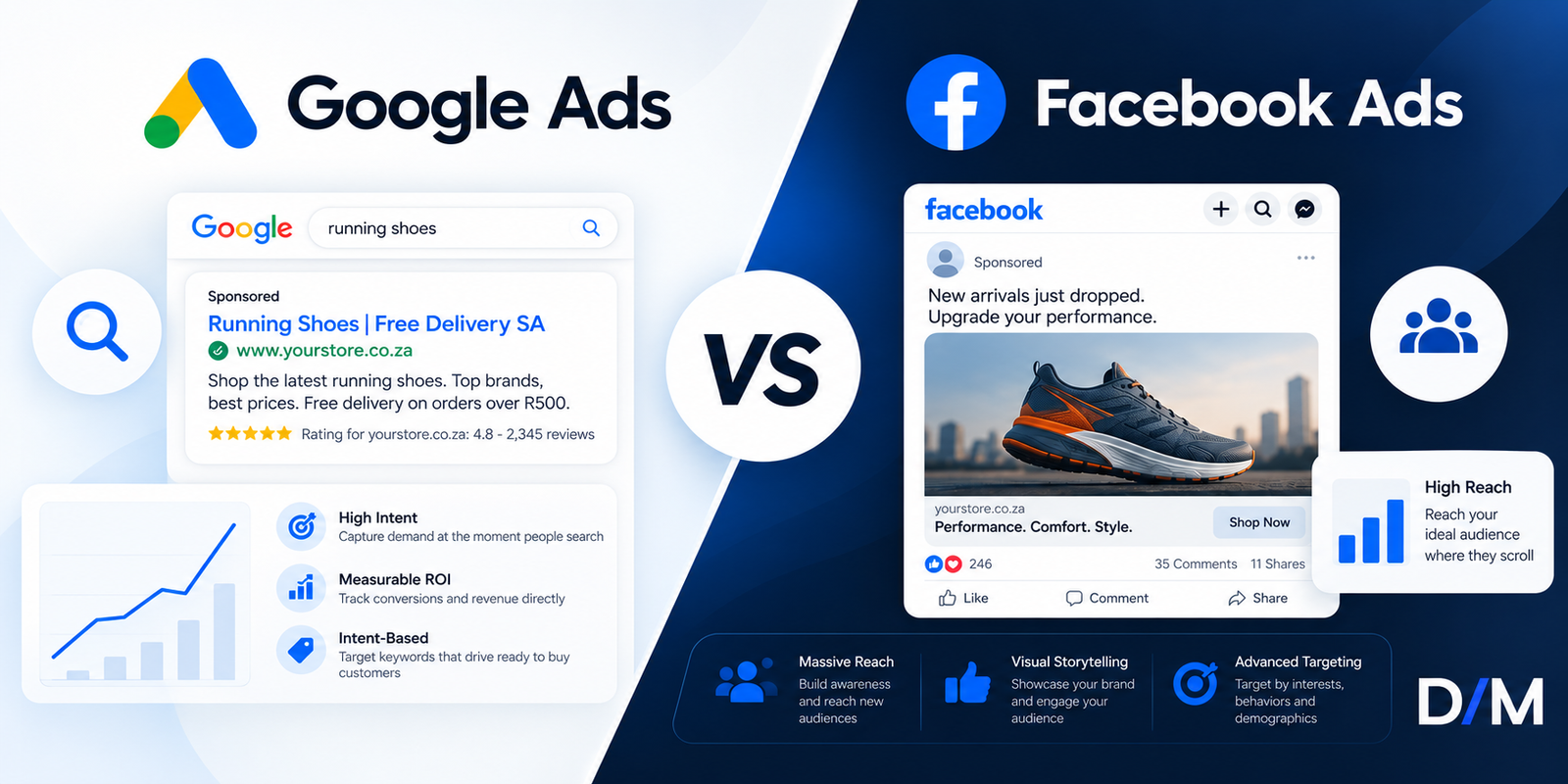
Google Ads vs Facebook Ads - which one should you pick?
Both Google and Facebook Ads are powerful paid advertising platforms in South Africa. Depending on your business, goals and advertising creatives you may choose the one over the other or use a combination of both.
Benefits of Google Ads
- High relevance. Search advertising allows you to be visible when a customer actively searches for your product or service.
- Many ad formats. Access to Google's ecosystem of inventory across search, shopping, apps, display, Gmail, YouTube and discovery.
- AI campaign types. Performance Max automatically optimizes marketing channels and devices based on your advertising goals.1
- Full funnel marketing capabilities. You can conduct brand lift studies, measure phone calls, track lead forms, track sales and even ROI through the platform.
- Advanced marketing strategies available within the Google Ads platform. From customer match targeting to adjusting bids based on devices or including only certain suburbs.
- Ads for products are well suited. A big bonus for e-commerce stores, product ads are well supported on Google Shopping and Performance Max campaign types.
Benefits of Facebook Ads
- Time on platform. Potential customers spend a lot of time on the Facebook platform - 27.9 million South Africans were on Facebook in late 2025.2
- Audience targeting depth. Excels in advanced audience targeting and granular segmentation through demographics, interests, and behaviors.
- Diverse ad formats. Enhance quality engagement and adapt seamlessly across devices for impactful messaging.
- Optimized creatives. Personalized messaging, and compelling visuals drive higher engagement rates on Facebook ads.
- Lower cost-per-click. Greater ROI flexibility across a wide range of marketing budgets.
- Top of mind awareness. You can expose your audience to your core messaging quite well.
- Community building characteristics. Building communities and fostering authentic engagement are strategic advantages.
Google Ads vs Facebook Ads - audience targeting differences
While both platforms are industry leaders, their core differences shape how brands connect with users and meet marketing objectives. Google Ads operate within the vast search network, targeting users' intent, while Facebook Ads thrive in the social realm, enabling nuanced audience targeting and community engagement.
Determining whether your product leans towards a social media environment or whether it's better suited when searched for is at the heart of the debate if you can only choose one to start with.
Audience targeting shapes the very foundation of campaign success across digital platforms, especially when deciding between Google Ads and Facebook Ads.
Savvy marketers recognize that understanding how each platform approaches users, leverages user intent, and nurtures communities is crucial for effective digital marketing. While Google Ads emphasize intent-based targeting, Facebook Ads stand out by empowering businesses to engage niche audiences, build thriving social communities, and nurture loyal users across varied interests.
Recognizing these distinctions equips marketers and businesses with the clarity to align digital advertising strategies, drive superior results, and maximize ROI across both digital platforms. Let's explore what sets these giants apart in digital marketing.
Conversion rates: differences between the platforms
Typically you can expect high lead form conversion rates on Facebook lead form ads with a low cost per lead. However, many of these leads won't be qualified since users can auto-fill their details and many users are just curious about your offer.
Google will normally have a lower lead volume and higher cost per lead when compared to Facebook. In essence, with Google you can receive warmer leads. If your keyword targeting is well selected, you'll have a higher lead to qualified lead conversion rate than Facebook.
Assessing quality and ad formats for impactful messaging
When deciding between Google Ads and Facebook Ads for your digital advertising strategy, understanding how each platform delivers quality, impactful messaging is crucial.
The creative assets you have and can produce are of critical importance when deciding between Google Ads & Facebook Ads.
Google advertising: keys to success
Relevancy is one of the most repeated words in the Google Ads help documentation and for good reason. Google's mission is to organise the world's information and the ads component is a part of that process.
- Ensure your ad copy is relevant to the search term.
- Bid on keywords closely related to your business.
- Send visitors to the exact page and information they are looking for.
- Enhance your ads with ad extensions to increase your quality score and prominence.
Tracking and goals is another cornerstone of advertiser success. Ensure the goals that you've selected and tracked are closely related to your overarching business goals.
No successful Google Ads campaign is complete without a landing page.
Facebook advertising: keys to success
- Focus on high quality, engaging and topical creatives.
- Provide a diverse set of creatives to avoid fatigue from your users.
- Target specific users by using Facebook's deep demographic targeting. Micro-level targeting ensures that campaigns reach users at the right moments, in the right context, and with messaging tailored to resonate at a personal level.
- Learn from organic content that has worked in the past - it could make a great Facebook advertisement.
- Call out your audience in the first few seconds of a video ad. The platform's AI with the Andromeda update now matches users to creative elements.3
Facebook Ads: reaching niche markets and building communities
In today's fast-moving digital world, brands that want to thrive know the importance of connecting with highly targeted users. Facebook Ads bring unparalleled power to audience targeting, making it possible for advertisers to reach not just broad demographics but specific niche markets that fit their exact marketing goals. The social platform's ecosystem is built on expansive, real-time data drawn from how users interact, share, and participate in online communities, giving marketers a rich foundation for designing precise and impactful advertising campaigns.
Digital marketing thrives on engagement, and Facebook Ads excel because they naturally embed advertising within the user's social experience. Unlike Google Ads' traditional search results, Facebook Ads appear in users' feeds, Stories, and Messenger, formats built to drive interaction and encourage social sharing. This creates a feedback loop where marketers can analyze and react to engagement metrics in real time, refining audience targeting for future campaigns.
The platform's algorithms continuously learn user behaviors, helping advertisers allocate budget more efficiently by resurfacing ads to those most likely to convert or engage. This adaptability, coupled with detailed insights, gives Facebook Ads an edge in crafting marketing strategies that feel individualized while still scaling across massive user bases.
Maturing your PPC campaigns
Brands today need to have a holistic PPC strategy and move beyond basic ad deployment and focus on how unique ad formats shape user engagement, especially across a variety of devices. From classic Google display ads to dynamic product placements, the ability to tell your story with clarity and impact relies on the platforms' commitment to ad quality, the flexibility of formats, and seamless experiences for users.
In the end, both Google and Facebook advertising platforms complement each other quite well.
Google Ads vs Facebook Ads summary
- Choosing between Google Ads and Facebook Ads hinges on your business objectives, audience targeting needs, and budget.
- Both platforms offer unique strengths and can deliver powerful results when aligned with your marketing goals.
- As a business seeking the most impactful strategy, consider leveraging insights from both to maximize ROI.
- You can test the effectiveness of each. If you find that after 90 days and optimisation that it doesn't work for your goals you can always test an alternative.
References
3 sources
- 01About Performance Max campaigns - Google Ads Help - Google. Accessed 30 July 2026.↩
- 02Digital 2026: South Africa - DataReportal. Accessed 30 July 2026.↩
- 03Meta Andromeda: Supercharging Advantage+ automation with the next-gen personalized ads retrieval engine - Meta Engineering. Accessed 30 July 2026.↩